How Many Guitar Chords Do You Need to Start Playing Songs?
Mark Mannering Barton - Pick to Play Guitar
When you first start learning guitar, it can feel as though there is an enormous amount to remember.
You see chord books filled with hundreds of diagrams. Online lessons introduce new shapes every few minutes. Experienced guitarists seem able to move around the fretboard without thinking.
It is easy to assume that you need to learn dozens of chords before you can start playing proper songs.
The good news is that you don’t.
With just three or four carefully chosen chords, you can begin playing recognisable music, developing your rhythm and enjoying the reason you picked up the guitar in the first place.
The aim is not to collect as many chord shapes as possible.
It is to learn how to use a small number of chords musically.
You Can Play Songs with Three Chords
A huge number of songs are built around three or four chords.
The exact chords vary, but the basic principle stays the same. Music often uses a small group of chords repeated in a particular order.
That means you do not need to wait until you have developed an enormous chord vocabulary before trying to play songs.
Three chords played in time can sound far more musical than ten chords played hesitantly.
For a beginner, this is important.
Learning a few chords well allows you to start working on:
Changing between chords
Keeping a steady rhythm
Listening to the structure of a song
Playing along with a recording
Singing while you play
Building confidence
These are all skills you will continue to use as your playing develops.
Which Guitar Chords Should Beginners Learn First?
There is no single compulsory list, but some open chords appear particularly often in beginner-friendly songs.
A useful starting group might include:
G major
C major
D major
E minor
A major
A minor
E major
You do not need to learn all seven at once.
In fact, trying to do so may make your practice less productive.
Start with two chords that appear together in a song you enjoy. Once you can move between them with reasonable confidence, add a third.
The best first chords are not necessarily the ones a textbook tells you to learn.
They are the ones that help you begin playing music you actually like.
Knowing a Chord Is Not the Same as Using It
There is a difference between knowing where your fingers go and being able to use a chord in a song.
You may be able to form a G chord when you have plenty of time to arrange your fingers. The challenge comes when you need to move from G to C without stopping.
This is why learning chord combinations is more useful than practising isolated shapes.
Instead of playing one chord repeatedly, practise moving between two chords.
For example:
G to C
G to D
A to D
E to A
A minor to C
E minor to G
Move slowly at first.
Focus on preparing your fingers for the next shape rather than waiting until the final moment.
The aim is not immediate speed. It is a smooth, repeatable movement.
Two Chords Played Well Beat Ten Played Badly
Beginners sometimes rush from one new chord to the next because learning something new feels like progress.
You may finish a practice session able to recognise ten chord diagrams, but still struggle to play through a complete song.
That can become frustrating.
A more useful goal is to take two or three chords and become comfortable enough with them that you can keep playing.
The chord changes do not have to be perfect.
You may still pause slightly or miss the occasional string. What matters is that you are developing control and beginning to understand how the chords connect.
Depth is more useful than quantity.
Knowing fewer chords well will usually help you make music sooner than knowing many chords vaguely.
Rhythm Makes Simple Chords Sound Like Music
The chords are only one part of a song.
The rhythm is what brings them to life.
You could play the same three chords in several different ways and create a completely different feeling each time.
A slow, gentle strumming pattern may make the progression sound reflective. A stronger and more regular pattern may make it feel upbeat. Playing only on certain beats can completely change the character again.
This is why rhythm should be introduced early.
You do not need a complicated strumming pattern. Start by strumming once on each beat and keeping the movement steady.
Count:
“One, two, three, four.”
Change chord at the beginning of the next group of four.
Once that feels manageable, you can begin adding more strums without losing the beat.
A simple rhythm played confidently will nearly always sound better than an advanced pattern that keeps stopping.
Start with Simplified Versions of Songs
The original recording of a song may include:
Barre chords
Unusual chord voicings
Fast changes
Lead guitar parts
Fingerpicking
Several layers of instruments
You do not have to reproduce all of that immediately.
A simplified version can help you understand the song and start enjoying it much sooner.
You might use:
Easier open chords
A capo to change the key
One strum per beat
Fewer chord changes
A shorter section of the song
A simplified version of a difficult chord
This is not cheating.
It is a practical way to build the skills needed for the fuller version later.
Every experienced guitarist has adapted music to suit their ability, their instrument or the situation in which they are playing.
What About Barre Chords?
Many beginners worry about chords such as F major because the full barre chord can be difficult at first.
You do not need to master barre chords before you can play songs.
There are often simpler versions available.
For example, you may be able to play a smaller version of F using only the highest four strings. This allows you to use the chord in a song while gradually developing the strength and technique required for the full version.
Barre chords are useful, but they do not need to become a barrier between you and making music.
Build towards them over time.
Learn Chords Through Songs, Not Just Diagrams
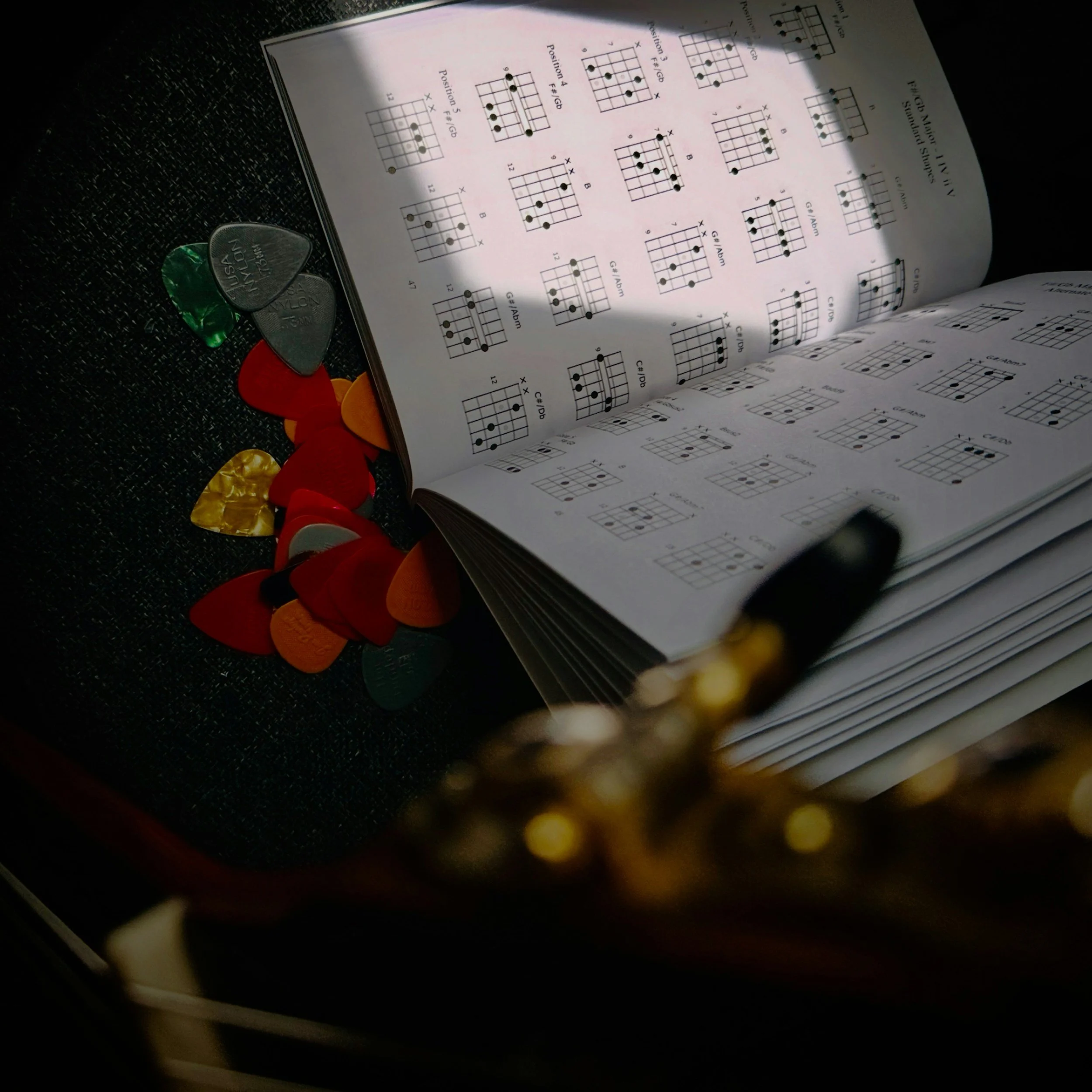
Chord diagrams are useful, but they are only a map.
The music is the destination.
Learning chords through songs helps give each shape a purpose. You begin to understand how it sounds, where it appears and which other chords commonly sit beside it.
It can also make practice more memorable.
Instead of thinking:
“I need to practise G, C and D.”
You can think:
“I am learning the chords for a song I have always wanted to play.”
That change in perspective can make a big difference to motivation.
When Should You Add More Chords?
Add another chord when the ones you are practising feel reasonably familiar.
They do not need to be perfect.
A useful sign is that you can:
Form the shapes without checking every finger
Change between them at a slow tempo
Keep a simple rhythm going
Use them in part of a song
Recover after making a mistake
At that point, one new chord can open up several more songs.
Build your chord vocabulary gradually and with a purpose.
Do Not Wait Until You Feel Ready
Many adult beginners believe they need to complete a certain amount of preparation before they are allowed to play songs.
They practise shapes, exercises and scales while postponing the music they actually want to make.
You do not need to earn the right to play songs.
Songs can be part of how you learn from the beginning.
Your first version may be slower, simpler and less polished than the recording. That is completely normal.
The important thing is that you are playing music rather than endlessly preparing to play music.
So, How Many Chords Do You Really Need?
You can start making music with two chords.
With three or four, you can begin playing a wide range of songs.
As you gradually add more, your options will expand.
The number of chords you know matters far less than what you can do with them.
Focus on:
Clear enough chord shapes
Smooth, gradual changes
A steady rhythm
Songs you genuinely enjoy
Regular, manageable practice
You do not need to know everything before you begin.
Choose a few chords, find a song and start playing.
Ready to Start Playing Real Songs?
If you would like to learn guitar without getting buried in endless theory or exercises, I offer relaxed, one-to-one lessons designed specifically for adult beginners.
We can work with music you enjoy, simplify songs to suit your current ability and build your chords, rhythm and confidence one practical step at a time.
Pick to Play Guitar offers face-to-face lessons in Teddington and the surrounding areas of Richmond, Twickenham, Kingston, Hampton and Hampton Hill. Online lessons are also available across the UK.
Ready to starT playing?
Whether you're picking up a guitar for the very first time or returning after a long break, I'd be delighted to help you build solid foundations and enjoy the learning process.
Pick To Play Guitar offers relaxed, one-to-one lessons for adult beginners across Teddington, Twickenham, Richmond and the surrounding areas or UK wide online. Together we'll make learning the guitar enjoyable, rewarding and, most importantly, fun.
Get in touch today for a friendly chat about your guitar journey. I'd love to help you get started.
Book your free intro call
(see link on the Header of the website or Contact Me Here
For recomended Gear
I’m always asked for gear advice so I’ve started putting a page together so do look Here